HomeDeaf EducationKelston Deaf Education Centre (Ko Taku Reo)

Kelston Deaf Education Centre (now Ko Taku Reo; previously Kelston School for the Deaf). Kelston was established on a site in Archibald Road in 1958. The school had relocated firstly from Titirangi, then from Mt Wellington. KDEC used to provide education in a range of satellite classes throughout Auckland, the upper North Island. Kelston, which also hosts Rūaumoko Marae, merged with van Asch Deaf Education Centre to become Ko Taku Reo in 2020.

A New Era in Deaf Education

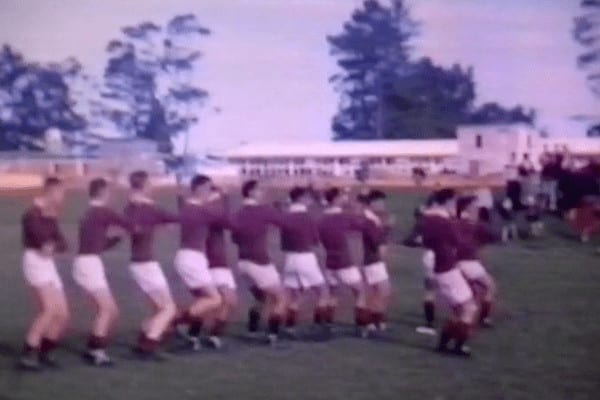
Kelston saw the celebration of many events that brought together the school community including the infamous ‘Te Pakanga o Whau’ (The Battle of Whau) in 1959 where 86 deaf students acted in a play featuring a Maori-Paheka battle on the sports fields.

1959, The Battle of Whau.

Deaf education in Auckland began during World War Two as it was perceived to be too dangerous to send children to Sumner School for the Deaf at that time as it would involve travel across the Cook Strait, so all North Island Deaf children were sent to a new Deaf school in Titirangi, Auckland. When it was taken over by the army, the school temporarily relocated to a site in Mt Wellington. Kelston School for the Deaf (Kelston) was established on a site in Archibald Road in 1958.

Deaf units connected to Kelston were established in the 1960s, which saw more Deaf children being placed, or ‘mainstreamed’ in regular schools.

In the 1960s, the school’s efforts were focused on the speech training of Deaf children. The use of Total Communication and Australasian signs was introduced in 1975 and this caused some division amongst the teachers. After lobbying by parents, teachers and the community, the Total Communication philosophy was given official recognition by the Department of Education in 1977-78.

NZSL for learning

1995, Cheryl Anton with children (Source: Kelston Deaf Education Centre).

1995, Kelston’s museum (Source: Kelston Deaf Education Centre).

By 1995, NZSL was given a place in education. This saw the development of the first bilingual class, the Deaf Studies programme, the employment of Deaf Language Assistants as language models for deaf students and communication skills workshops to staff and families. NZSL Educational Interpreters were used for the first time in the classroom in 2000. The NZSL Curriculum was established in 2006 so that all schools could provide opportunities for students to study NZSL. It was not until 2014 that the Ministry of Education agreed to fund the development of NCEA Achievement Standards so students could gain a formal qualification in NZSL.

Kelston is home to Rūaumoko Marae, the only Deaf marae of its kind in the world which opened in 1992. In 1995, the Museum of Deaf Education opened in the old hostel block.

New Developments

Staff members: The 1995 Deaf Festival was the first deaf cultural festival to take place in New Zealand.

There was a name change to Kelston Deaf Education Centre in 1991 to reflect the wide range of services. Kelston provided a range of services to deaf pupils and their families, whanau and staff in schools throughout the Upper North Island, north from Turangi and Opotiki. Resource Teachers of the Deaf worked with deaf students in over 400 schools across the Upper North Island. All staff were committed to deaf learners having full access to NZSL and/or English in order to improve their language and communication skills.

In 2014, major building work began to completely rebuild the main site at Archibald Road to bring it into the 21st century. The Administration, Residential and Resource services along with the Pre-school and the Ruāmoko Marae will be on site, with enrolled students located at partner schools in the Auckland region and beyond.

Kelston Deaf Education Centre merged with van Asch Deaf Education Centre in 2020 to become Ko Taku Reo.

Reference: Hamilton, S., (2012) ‘The Chronicles of Titirangi, Mt Wellington & Kelston Schools for the Deaf,’ Kelston Deaf Education Centre.

Note: This page was last updated 2020. Contributions are welcomed.

reset filter
1966
publication – Taonga source: New Zealand Deaf News

NZ Deaf News: Autumn 1966 (Vol. 3, No. 3)

NZSL Stories
  • John Hunt
1995
video – Taonga source: Television New Zealand Archive

Michael Wi, Māori Deaf

Michael Wi, is profiled on ‘Marae’, where he shares his experience of growing up as Māori Deaf in a paheka-centric education environment, and learning as an adult about tikanga Māori, and marae protocols.
Television New Zealand Archive
1973
publication – Taonga source: New Zealand Deaf News

NZ Deaf News: 1973 (Vol. 10, No. 2)

1969
publication – Taonga source: New Zealand Deaf News

NZ Deaf News: October 1969 (Vol. 6, No. 4)

NZSL Stories
  • John Hunt
1991
publication – Taonga source: National Foundation for Deaf and Hard of Hearing

NFD Journal: September 1991 (Vol. 5, No. 3)

National Foundation for Deaf and Hard of Hearing
1992
publication – Taonga source: National Foundation for Deaf and Hard of Hearing

NFD Communicate: March 1992

National Foundation for Deaf and Hard of Hearing
NZSL Stories
  • Patreena Bryan
  • Susie Ovens
  • Tony Walton
  • Shona McGhie
  • John Mansell
1967
publication – Taonga source: New Zealand Deaf News

NZ Deaf News: Autumn 1967 (Vol. 4, No. 3)

NZSL Stories
  • John Hunt
1959
video – Taonga source: Susan Hamilton

Extended version: Te Pakanga o Whau performs at the opening ceremony of Kelston

The opening of Kelston on a site in Archibald Road featured the infamous ‘Te Pakanga o Whau’ (The Battle of Whau) in 1959 where 86 deaf students acted in an outside play featuring a Māori-Pakeha battle near a big gum tree field.
Susan Hamilton
1970
publication – Taonga source: New Zealand Deaf News

NZ Deaf News: 1970 (Vol. 7, No. 4)

NZSL Stories
  • John Hunt
1989
article – Taonga source: The Dominion

Board of trustees accepts extra challenges at school for deaf

Board member Ava Buzzard, who has been deaf since birth, is excited by the chance to have a greater role in a school she has been involved with for many years.
1992
video – Taonga source: Susan Hamilton

Sports Day at Kelston Deaf Education Centre

Kelston Deaf Education Centre hosts its annual sports day, with athletics, swimming and prizegiving.
Susan Hamilton
1960
article – Taonga source: The Auckland Star

A winter treat for the deaf

A group of 44 deaf youngsters from Kelston School for the Deaf take a two-day visit to the Ruapehu snowfields.
1996
video – Taonga source: Television New Zealand Archive

A look into the new bilingual approach at Kelston Deaf Education Centre

One of the goals of 1996’s Deaf Awareness Week was to better educate New Zealanders about New Zealand Sign Language, and as part of this, One Network News visited Kelston Deaf Education Centre in Auckland. KDEC which has a new bilingual teaching method using both NZSL and English.
Television New Zealand Archive
2022
article – Taonga source: Stuff

Aotearoa’s first Deaf marae celebrates 30 years of empowering Turi Māori

Friday marks 30 years since the opening of the country’s first marae for Deaf and hard of hearing Māori. Since 1992, Rūaumoko Marae, in West Auckland’s Kelston, has been a place where Deaf students can learn about te ao Māori.
Stuff
1961
video – Taonga source: Susan Hamilton

Kelston School for Deaf sends its netball and rugby teams to Russell

Kelston School for Deaf sends its netball and rugby teams to Russell.
Susan Hamilton
NZSL Stories
  • John Mansell
1998
publication – Taonga source: National Foundation for Deaf and Hard of Hearing

NFD Communicate: Summer 1998

National Foundation for Deaf and Hard of Hearing
1993
video – Taonga source: Television New Zealand Archive

Sounds or Silence?

In the early 1990s, due to a breakthrough in technology, cochlear implants were starting to become the norm. The Deaf community worldwide viewed cochlear implants as a device that disregarded the need for access to sign language. Others considered such devices a miracle. In 1993, ‘60 Minutes’ investigated this controversial topic in New Zealand.
Television New Zealand Archive
2001
article – Taonga source: Unknown

Loud and clear

The deaf community believes it has been misunderstood and misinterpreted for too long. Now it wants to be seen and heard as a group with its own cultural identity.
1968
publication – Taonga source: New Zealand Deaf News

NZ Deaf News: Winter 1968 (Vol. 5, No. 4)

NZSL Stories
  • John Hunt
  • John Mansell
1986
video – Taonga source: Ngaire Doherty

A ‘Mime and Masks’ show by Deaf Drama Group: A Visit to Kiwiland

A Deaf Drama group perfoms 'A Visit to Kiwiland' at Kelston with supporting acts by the Sign Singers. The evening fundraised $766.00 towards the purchase of a TTY and to sponsor two pupils from Kelston to attend the World Deaf Games in Christchurch 1989.
Ngaire Doherty
NZSL Stories
  • Jeff Went
  • Shona McGhie
  • Pam Croskery
  • Susie Ovens
  • Tony Walton
1998
article – Taonga source: The Dominion

New Zealand’s first bilingual deaf unit

New Zealand's first official "bilingual" deaf unit attached to a primary school will be opened next week. The unit teaches both NZSL and English. Mr Buchanan, who will head the unit, is one of six deaf teachers teaching the deaf in New Zealand.
2018
video – Taonga source: Deaf Children New Zealand

NZSL and Us: Zenos Tamihana, Auckland

Zenos Tamihana comes from a large, loving family that cares deeply about his communication needs. He is a lively, happy young boy who loves sports and attends Kelston Primary School in Auckland. Zenos has a teacher who is Deaf herself and uses NZSL in class. Zenos thrives at home and at school largely thanks to full access to language and communication.
Deaf Children New Zealand
1997
article – Taonga source: NZ Herald

Deaf woman goes to head of class

Struggles in her own schooling as she grew up made profoundly deaf Auckland woman Sarah Cameron want to be a teacher. Her ambition came true yesterday when she became the first deaf person to graduate with a mainstream secondary teacher's diploma.
1969
publication – Taonga source: New Zealand Deaf News

NZ Deaf News: 1969 (Vol. 7, No. 1)

NZSL Stories
  • Kevin Pivac
  • John Hunt
  • John Mansell
1991
video – Taonga source: Television New Zealand Archive

Māori Deaf and Deaf education

A look at the cultural education needs of Māori Deaf students. Māori Deaf are likely to experience more barriers in the education sector. Interviews undertaken by ‘Marae’ shows us that the multiple cultural identities of Māori Deaf are not completely accommodated for with aspirations on how to resolve this.
Television New Zealand Archive
2016
video – Taonga source: Attitude Pictures

Deaf Teen’s New School

Gaby Evans is 13 and moving hundreds of kilometres from her rural home to Auckland's Kelston Deaf Education Centre. Until now she's been isolated, and never had to know how to sign. If she's going to make it on her own she's going to have to come out of her shell and learn to communicate with her deaf classmates.
Attitude Pictures
1992
article – Taonga source: Western Leader

Deaf learn Maori culture

A Maori house of learning for deaf children was opened at the Kelston Deaf Education Centre in Auckland yesterday after many hours of voluntary work by deaf adults and pupils.
1956-57
video – Taonga source: Susan Hamilton

Kelston School for Deaf: Clearing of the Ground and Construction

Students from the Titirangi School for the Deaf visit the construction site of the future Kelston School for the Deaf.
Susan Hamilton
NZSL Stories
  • Patreena Bryan
1995
publication – Taonga source: National Foundation for Deaf and Hard of Hearing

NFD Communicate: September 1995

National Foundation for Deaf and Hard of Hearing
NZSL Stories
  • John Mansell
  • Kevin Pivac
  • Shona McGhie
1960
video – Taonga source: Susan Hamilton

Formal opening of Parau, a beach property with a large brick hostel

Parents of deaf children raised thousands of pounds to buy a beach property at Parau where a large brick hostel was built. Groups of children, teachers and parents spent many a happy weekend there.
Susan Hamilton
NZSL Stories
  • Patreena Bryan