
1973
Object – Taonga source: Te Papa Tongarewa, Museum of New Zealand
Teletypewriter (TTY) coupler


1988
video – Taonga source: Television New Zealand Archive
Spot On interview of Deaf actor in ‘Strangers’
'Strangers' was a TVNZ-produced drama series for children, with one Deaf character played by 7-year-old Sonia Pivac. Reporter Phil Keoghan, from ‘Spot On’, interviews Sonia about being the only Deaf actor in the drama.


1989
article – Taonga source: Wellington Deaf Society
Sign language boost
Research on the complex sign language that deaf New Zealanders have created could push education authorities to recognise the language's authenticity. It has taken an American linguist to document the distinctive language.


2000
video – Taonga source: Dorothy Jones
Manawatu Deaf community farewells Terry O’Brien
The Manawatu Deaf community thanks Terry O’Brien for his service as a Teacher of the Deaf. Terry taught for over 30 years at Freyberg High School in Palmerston North which had a Deaf Unit that St Dominic’s pupils often went on to attend.


1996
Images – Taonga source: Auckland Deaf Society
Group Photo: Northern Team, 39th N.Z. Deaf Games, Auckland 1996

NZSL Stories


1993
article – Taonga source: The Press
Cash-strapped deaf school axes jobs
Twenty-three of the 39 residential care staff at van Asch College were made redundant yesterday as a result of Government funding cuts last year.

2000
publication – Taonga source: Oticon Foundation
Soundscape: November 2000


2017
publication – Taonga source: Deaf Education History Aotearoa NZ
Yearbook: van Asch Deaf Education Centre, 2017

1993
article – Taonga source: City Voice
Deaf viewers ask for a hand
People who can hear as well as see 'Reasonable Doubts' (TV3, 9.50pm Saturdays) might be surprised to learn that Deaf New Zealanders can understand deaf lawyer Tessa Kaufman’s sign language little better than they can. ASL, used by Deaf actor Marlee Matlin, is a foreign language here. My Deaf friends give it the thumbs up. But the failure of television in New Zealand to provide anything in NZSL is described as “a running sore” by Hilary McCormack.
NZSL Stories

1950
article – Taonga source: The Dominion
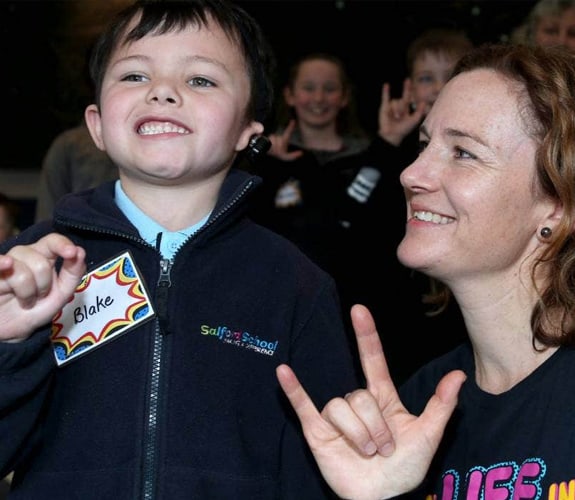
World Authorities Meet Deaf Wellington Children
Dr. A.W.G. Ewing and his wife, Dr. Irene Ewing, English authorities on the education of the deaf, with some of the pupils of St. Dominic's School for the Deaf, Island Bay, Wellington. The Ewings are here at the invitation of the Government to advise on education in their field.
2019
article – Taonga source: Stuff
New Zealand’s two deaf education centres to merge
New Zealand's two deaf education centres will become one next year as Kelston Deaf Education Centre and van Asch Deaf Education Centre merge from Term 3, 2020.


Est. 1992
COLLECTIONS – CURATED BY SIGNDNA: DEAF NATIONAL ARCHIVE
Rūaumoko Marae
Rūaumoko Marae has been part of Deaf Māori community for 30 years and is a central part of Deaf Māori community. It's a place where Deaf Māori can just be; they can connect and learn about te ao Māori.

2016
publication – Taonga source: Deaf Education History Aotearoa NZ
Yearbook: van Asch Deaf Education Centre, 2016

1954
article – Taonga source: St Dominic’s Catholic Deaf Centre
Additions To School For The Deaf: Opened At Fielding By Archbishop McKeefry
A great step forward in what is a unique work of Christian charity and education in New Zealand was taken last Sunday, November 28, with its opening. The additions to the school consist of a splendid new block providing classrooms and dormitories.


1964
video – Taonga source: Susan Hamilton
The Governor-General and his wife visits Kelston School for the Deaf
The Governor-General Sir Bernard and Lady Fergusson visited Kelston School for the Deaf on 4 April 1964. They were entertained by swimming and gymnastics display by its deaf pupils.


2004
video – Taonga source: Rūaumoko Komiti
Opening of the Advance Centre
The opening of the Advance Centre, a tertiary support centre for Deaf and hearing impaired students in the Auckland region, attended by Hon Ruth Dyson, Minister for Disability Issues, and Patrick Thompson - Māori Deaf leader.


biography
Profile
Anthony ‘Tony’ Walton (CNZM)
Tony received the Companion of the New Zealand Order of Merit in 2001 for his services to the Deaf community. Tony has had a broad involvement in many areas of the Deaf community, having been President of the NZ Deaf Sports Association and successfully hosting the World Deaf Games in 1989.
NZSL Stories

1946
article – Taonga source: St Dominic’s Catholic Deaf Centre
Teaching The Deaf To Speak
Margaret is one of some 21 kiddies, aged from five to seven years, who for the most part born deaf, are receiving special instruction at St. Dominic's School for the Deaf at Island Bay, Wellington, the first Catholic institution of its kind to be established in the Dominion.

1967
publication – Taonga source: New Zealand Deaf News
NZ Deaf News: 1967 (Vol. 4, No. 4)
NZSL Stories


1973
article – Taonga source: Pam Witko
Teacher Of Deaf Dies, Aged 64
The principal of the School for the Deaf, Sumner, died in Christchurch today after a short illness. Herbert Pickering was 64 years old.


1992
article – Taonga source: Western Leader
Curry case highlights Deaf plight
A television documentary on the plight of a deaf man has spurred the Glen Eden-based New Zealand Association of the Deaf into action. It wants to see the man, wrongly imprisoned for two years, receive compensation for his ordeal.
NZSL Stories

1956-57
video – Taonga source: Susan Hamilton
Kelston School for Deaf: Clearing of the Ground and Construction
Students from the Titirangi School for the Deaf visit the construction site of the future Kelston School for the Deaf.
NZSL Stories


2017
video – Taonga source: Meghan Coppage
Memories of Susan Hamilton
Susan Hamilton is interviewed by Meghan Coppage, where she recounts a range of experiences from her life. From growing up at a Deaf school, to her memories of time in the Deaf community in bygone days, to seeing the changes at Kelston Deaf Education Centre including the transition to new school building.


1998
video – Taonga source: Kevin and Lynette Pivac
NZ Deaf Rugby Team in Wales
See Hear reports on the New Zealand Deaf Rugby team’s tour of the UK in 1998.

NZSL Stories


1985
article – Taonga source: Unknown
Desperate need in N.Z. for interpreters
Qualified interpreters are desperately needed to cope with the needs of deaf people in New Zealand.
NZSL Stories
2017
article – Taonga source: Stuff
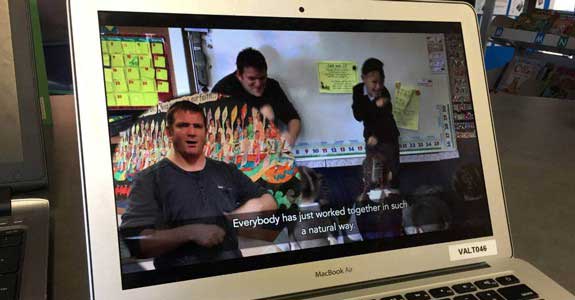
St Theresa’s School sets example for NZSL friendly schools
A Porirua school is being heralded as a great example of inclusive education. St Theresa's School in Plimmerton is the focus of a new short documentary by van Asch Deaf Education Centre, which will be used as a resource to show how to effectively integrate deaf education and culture into schools.

1989
article – Taonga source: The Dominion
‘Real’ sign language studied
Deaf people have evolved a sophisticated language which is little understood by hearing people and is officially ignored, according to American linguist Marianne Collins-Ahlgren.

1988
publication – Taonga source: National Foundation for Deaf and Hard of Hearing
NFD Journal: December 1988 (Vol. 2, No. 4)

NZSL Stories


1980
article – Taonga source: Zealandia
Deaf sponsor nun on trip of faith
The Wellington Catholic Deaf Association is sending a Dominican nun to conferences in Hamburg and Manchester.
NZSL Stories

2001
Images – Taonga source: Clive Morgan
Team Photo: Wellington/Central Districts Deaf Men’s Basketball Team, 2001

NZSL Stories