Deaf people CAN lead a ‘normal’ life….
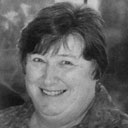
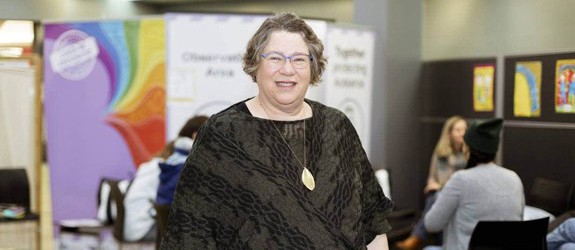
Val Jillings is deaf. The product of deaf parents and a mother of four deaf children, she can’t see any point worrying about her predicament.
Val is the mouthpiece for many of the deaf people in Auckland who are unable to talk effectively for themselves.
She’s a businesswoman, a public speaker — who needs two aids to hear herself speak – a court interpreter for deaf offenders, vice-president of the Auckland Deaf Society and an active organiser in this International Year of the Disabled Person.
“I try to be a good deaf person,” says Val. “I try not to sit around. There’s no good worrying about it. You have to be philosophical.”
Val may be a disabled woman living in an able bodied person’s world, but she hopes to try to educate others.
...
As a youngster Val had no problems with hearing. Both her parents and her younger brother were deaf, so she learnt lip reading, and sign language at an early age.
“I was the ears for my family,” explains Val. “I listened for them and helped them.”
It was only when she got to high school that Val began to have hearing problems.
“The headmistress said I should have a hearing aid because of my increasing difficulties, and my mother became very offended,” remembers Val with a smile. “She was so determined that I would not be deaf that she wouldn’t listen and made me leave school.”
Val took up a dress making apprenticeship and slowly became deafer.
Today she has an 85% hearing loss and can only just hear herself speak if she wears her two hearing aids.
Val married – a hearing man – and had four deaf children.
“In those days people didn’t know much about the causes of deafness and we didn’t think it might be hereditary.”
Val set about teaching her children to speak at a very young age. All of her children were post-lingual deaf children – they went deaf after they learnt to speak.
Pre-lingual (or profoundly deaf) people usually have major problems learning to speak clearly because at no time in their lives can they actually hear themselves speak.
Val’s oldest son, Ken Brain (now aged 37) was a bright child who learnt to speak well – a “real bookworm.”
“They wanted to send him to a deaf school but I wouldn’t hear of it,” says Val. “I had seen enough of what a deaf education had done for my brother. He was bright too, but in those days deaf children only managed to gain a very sketchy education.”
So Val determinedly packed her son off to Avondale College — where he easily managed two years of normal secondary education before taking an apprenticeship as an upholsterer.
Today Mum and son have combined dressmaking and upholstery skills to run a successful upholstery and furniture factory in Henderson.
Running a business creates no problems for this partnership. No one would ever know that the pair are deaf…except for the fact that every time the phone rings in their factory a bright light flashes as well.
“We also have to ask our customers to look at us when they speak, then we get on fine,” says Ken.
In the early days of the business Ken worked in his Kelston home’s garage, with just a handful of tacks and a tack hammer. Today her operates a large factory and fills orders from all over Auckland.
His factory employs six staff and five are deaf.
Ken wouldn’t have it any other way. “Deaf workers are totally reliable. They don’t change their jobs every five minutes, they come to work every day and they don’t chat.”
The work is creative and satisfying – an important factor for a deaf person, who may be cut off from the outside world through shyness about his disability, or poor communication.
Ken and Val regularly give young people from Kelston School for the Deaf work experience, and try to draw out these visitors so they can learn to cope in a normal working environment.
One young man, who has worked for seven years in Ken’s factory spent two years at the Sheltered Workshop – “because nobody knew quite where to send him.
“He ended up totally reclusive and unable to communicate with anybody.”
After years of Ken’s and Val’s urging and help, this boy is about to seek his driver’s licence.
Both Ken and Val still have their criticisms of deaf education.
“It is all done on the hearing man’s terms. All education in New Zealand deaf schools was until very recently done orally – although there is now increasing use of total communication, which combines the use of fingerspelling, sign language and oral,” says Ken.
He believes deaf people spend a lot of time learning speech but not enough time learning language and reading skills.
“A lot of deaf people can’t even read the daily paper – they just get cut off totally from the outside world,”
Morning tea times at the Brain factory in Henderson are spent discussing — either orally or in sign language — the day’s news and just what is happening in the world.
As secretary of the New Zealand Association of the Deaf, Ken went to Bulgaria in 1979 to attend the World Federation of the Deaf Congress. Ken and one other deaf person were the first New Zealand representatives to attend this four-yearly congress – they went in search of a “sense of direction and priorities for the deaf people of New Zealand.”
Ken came away with lots of stimulating ideas and two priorities – the teaching of a standardised sign language throughout New Zealand in line with world trends; and the better education of the general public about deafness.
With his own family Ken has been extremely lucky.
Although married to deaf woman – Jennifer, the first deaf dental nurse in this country when Ken met her – the Brains have six children, all of whom are perfect hearing except for an adopted deaf son.
Before making the choice to have children Ken and Jennifer saw an ear specialist and were told the chances of producing deaf children were very high.
“But we looked at the quality of our lives and didn’t feel we were suffering…therefore we didn’t believe our children would suffer,” says Ken.
He is thrilled now to find that doctors believe deafness in the Brain family may finally have died out.
Ken remembers with a smile the difficulties of being a first-time parent.
“When we brought the baby home I was petrified that he would cry and we wouldn’t be able to hear anything was wrong.”
So Ken had specially made a flashing system which set off an extremely powerful set of bright lights when the baby cried. The device was expensive (at $200) but it has served the Brain household well.
Val remembers having to place the baby bassinet right beside her bed so that she could feel vibrations when the baby became restless or cried.
It wasn’t as sophisticated as the light systems but she reckons it worked equally as well.
As with most people who have lost of their prime senses, Ken and Val find that their other senses are heightened to compensate.
Ken has eyes like a hawk and can pick up visual details that most people miss, while Val can smell something burning minutes before anybody else.
Apart from the emotional setbacks and physical demands on learning to cope with deafness, it is an expensive business. Hearing aids — which need replacement every two years — cost $400 a pair; amplifiers on a telephone cost an extra $2 surcharge on every phone bill; and the latest in deaf gadgetry — a teleprinter that allows deaf people to “phone” other deaf people — costs $750.
This amazing piece of machinery, is according to Val, “the greatest invention ever for the deaf.”
The deaf teleprinter can be used in a phone box and can make international calls.
Val, through her public speaking on behalf of the deaf in Auckland, has earned a nomination as Deaf Woman of the Year from Quota International, a women’s service organisation operating in the South Pacific.
Caption beneath photo. Val Jillings and her deaf family. Seated are daughters Raewyn Hopkinson, an interpreter for the New Zealand Association of the Deaf and Barbara Cunliffe, a school teacher. Son Michael, who works in the family business, and in front are Jennifer Brain, who is the first deaf dental nurse in the country, Ken Brain with his adopted son and David, who is a 17-year-old general.
- TV/Media
- Other